Springs · Peterborough
Torsion Spring Replacement
You heard a sharp bang from the garage, and now the opener hums for a second and gives up. The door lifts a few centimetres at most, then settles back down as if something very heavy is holding it in place.
Torsion Spring Replacement
In plain words
Every spring is built for a number of open-close cycles, and replacement is a natural moment to choose that number deliberately. A standard residential spring is commonly rated around ten thousand cycles; a family that opens the door six times a day uses those up in a few years. Higher-cycle springs use heavier wire and a longer coil to produce the same force with less stress on the steel, so they last proportionally longer. The technician can explain the trade-off and fit whichever option suits the household's use of the door, then wind and balance it accordingly.
How the visit goesYou heard a sharp bang from the garage, and now the opener hums for a second and gives up. The door lifts a few centimetres at most, then settles back down as if something very heavy is holding it in place.
Peterborough
How the visit goes
Reading the spring itself
The first measurements come from the spring that is already on the shaft. The technician measures wire thickness across a run of ten or twenty coils, the inside diameter of the coil, the overall length of the spring when relaxed, and the wind direction, which is read from how the coils lean. On a two-spring door each spring is checked separately, because a left-wound and a right-wound spring sit on either side of the centre bracket. Any tag or colour marking is noted too. These numbers narrow down what the door was built with, and together with the door's weight they point to the correct replacement.
Winding with control
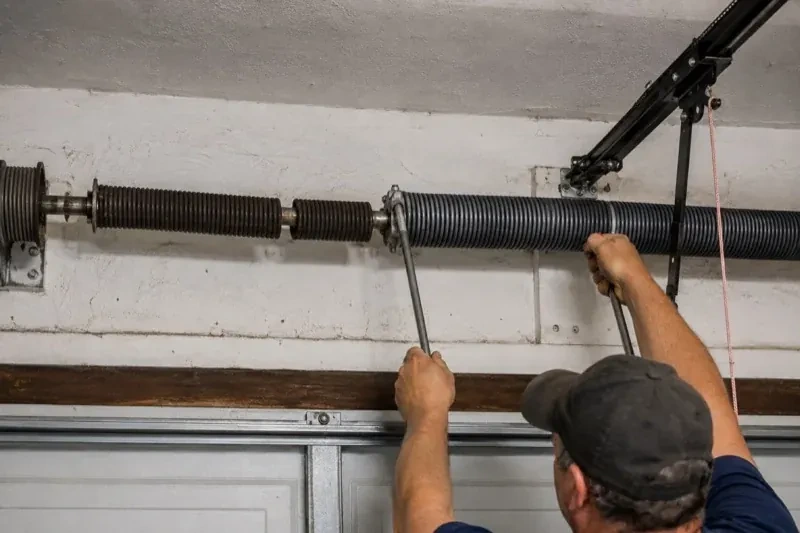
Winding is where a spring takes on its working tension, and it is done with two solid steel bars sized to the holes in the winding cone. The technician stands to the side of the cone, inserts one bar, turns a quarter turn, inserts the second bar, and transfers the load from bar to bar so the spring is never held by less than a full bar. The number of quarter turns is counted against the door height and drum type. When the count is reached, the spring is stretched slightly toward the drum and the set screws are tightened to the shaft while the last bar still carries the load.
Relief for the opener
Your opener benefits as much as the door. With the spring carrying the weight again, the motor, gear drive, trolley and rail return to the light duty they were designed for, which tends to mean a longer working life and less noise. Force settings have been reset to suit a balanced door, so the safety reversal reacts to a genuine obstruction rather than to a heavy door. Once a year, repeat the simple reversal test by placing a length of wood flat on the floor in the door's path and confirming the door reverses on contact. The opener's photo-eye sensors deserve a wipe at the same time.
Torsion Spring Replacement
In the van
- Socket set and wrenches
- End bearing plates
- Locking pliers for the track
- Lift cables
- Centre bearing bracket and bearing
What affects the quote
Same fees day, night or weekend
1Condition of the lift cables
Cables that show fraying, rust or a kink at the bottom brackets are replaced so the new spring pulls on sound steel. Two good cables mean this item stays off the list.
2Oversize or non-standard doors
Very wide doors, tall doors, carriage-house doors with heavy overlays and light-commercial doors may need duplex springs, multiple springs or larger drums, which changes both the hardware and the method.
3Shaft condition
A bent, badly rusted or worn shaft is replaced so the drums and bearings turn true. Coupled two-piece shafts and their coupler are checked at the same time.
Torsion Spring Replacement: questions
Why does the door need to be balanced, and how is that tested?
Balance means the spring is holding almost exactly the door's weight, so the door neither flies up nor slams down and the opener only guides it. It is tested by releasing the opener, lifting the door to about waist height and letting go: a balanced door stays there. The technician fine-tunes in quarter turns of the spring until the door holds at several heights and travels evenly on both sides.
Are springs different for a heavy wooden or insulated door?
Yes, and this is exactly why the door is weighed. A solid wood door or a thick insulated steel door can weigh far more than a single-skin steel door of the same size, so it needs heavier wire, a larger coil or a second spring to balance. The technician measures the actual weight and selects accordingly, so the finished door lifts as easily by hand as a lighter one.
My car is inside the garage; how do you get the door open?
Once the technician is on site, the door is secured and the spring replaced with the door in its closed position, which is how spring work is always done. When the new spring is wound and the door balances, it lifts normally and the vehicle drives out. There is no need to force the door open beforehand; leaving it closed keeps the door square and the job straightforward.
Springs & Hardware
- Garage Door Hinge ReplacementWatching from inside as the door opens, you can see the gap between the second and third panels…
- Garage Door Track Repair or ReplacementThe door has started rubbing the frame on the left, leaving a shiny stripe down the weatherstrip.
- Garage Door Cable ReplacementYour older door has springs along the tracks, and one cable has slipped off its pulley and dangles…
Torsion Spring Replacement near you
Shops, warehouses and service bays in Peterborough have their own list: rolling steel doors, heavy sectional doors, industrial operators, safety edges and high-cycle springs. Alongside our residential work, we service and replace all of these and can set up a maintenance schedule that fits your operating hours.