Openers · Auburn Mills
Garage Door Opener Diagnosis and Repair in Auburn Mills
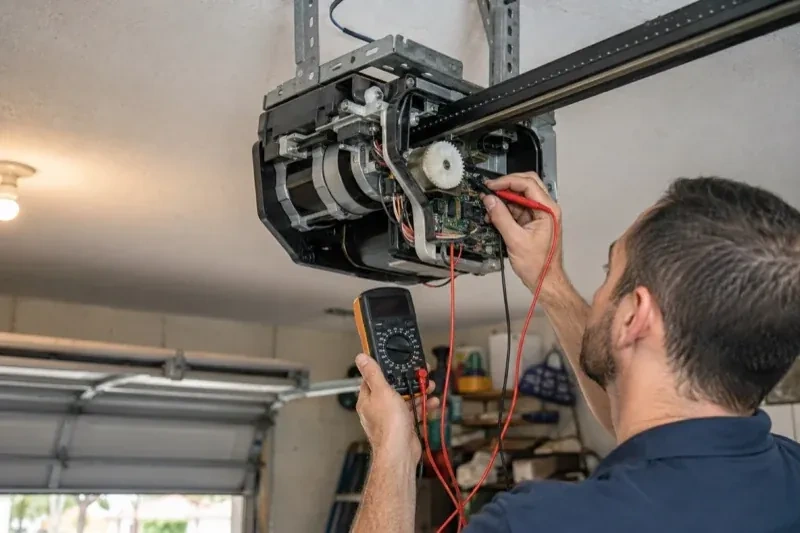
You press the remote from the driveway and hear the motor hum overhead, a steady drone with no movement behind it. The door stays shut.
Garage Door Opener Diagnosis and Repair
In plain words
Winter changes what an opener is asked to do. Grease in the gear case and on the rail thickens in the cold, rollers turn stiffly, and the bottom seal can freeze to the concrete overnight so the door is briefly glued shut. A force setting that was right in July now reads every one of those as an obstruction and stops. A cold-weather diagnosis sorts the seasonal from the structural: freeing the seal, lubricating the moving parts with a product made for low temperatures, checking that the balance is still right, and then confirming the force is low enough to stay safe while high enough to work.
How the visit goesFor a few days there was a grinding sound whenever the door started moving. Now the motor spins freely and the door stays exactly where it is. On the hood of the car there is a scatter of white plastic shavings that fell from the unit above.
Auburn Mills
How the visit goes
Limits, force and the two safety tests
Finally the settings are checked against what the door actually does. Travel limits decide where the door stops at the top and how firmly it meets the floor; a limit set slightly long makes the door hit the slab, sense an obstruction and pop back open. Force settings decide how much resistance the opener tolerates before reversing, and these drift, or get turned up to hide a stiff door. Both are read, the door is run through full cycles, and the contact reversal test with a 2x4 and the beam-interruption test are performed. Any setting that only passes because force is cranked high is treated as a symptom.
Controls, remotes and programming
Control faults are corrected at the control that failed. A wall console in lock mode is released by holding its lock button until the indicator stops flashing. Remotes get fresh batteries of the type the maker specifies, then are reprogrammed to the head unit with its learn button if the memory was cleared. Range problems are traced to interference, most often from certain LED bulbs in the opener's own sockets, and cured by swapping bulbs or extending the antenna wire. A wall control with a shorted or pinched cable gets new low-voltage wire; a failed receiver or wall control is replaced with one compatible with the opener's frequency and coding.
Ready for the cold months
After a winter diagnosis the door is set up for the season rather than for the day. The bottom seal has been freed and, if it was tearing, replaced, with a light silicone wipe so it releases from the slab. Moving parts carry a low-temperature lubricant. The photo eyes have been cleaned and, where low sun was blinding one, shaded or swapped side to side. Force has been set for a cold, stiff door without being pushed up to hide one. Keep snow and ice cleared from the threshold and the sensor lenses, and expect the door to be a shade slower on the coldest mornings.
Garage Door Opener Diagnosis and Repair
In the van
- Travel limit switch or RPM sensor
- Start capacitor
- Wall control
- Logic board or receiver
- Photo-eye sensor pair
What affects the quote
Same fees day, night or weekend
1Whether the door needs work first
If the by-hand check shows a heavy or binding door, the balance, rollers or springs are corrected before the opener is judged, and that door-side work is quoted as its own item.
2Sensor realignment versus replacement
Straightening a bracket and cleaning a lens is a small task. Replacing the sensor pair and running new wire along the wall and ceiling is a larger one, and the quote names which applies.
3Repair or replacement
When diagnosis points to replacement, the quote changes shape entirely: a new head unit, rail and sensors with installation, plus removal of the old opener, rather than a single part and labour.
Garage Door Opener Diagnosis and Repair: questions
How long does a diagnosis visit take?
The checks themselves run in a set order and take a modest part of an hour on most doors. What extends a visit is the repair that follows: a gear kit or capacitor adds a little, a sensor re-wire or a trolley change adds more, and a door-side problem such as a balance fault may mean a second piece of work. You are told where things stand once the cause is found, before any further work begins.
Can the force just be turned up so the door closes in winter?
Raising force is not the fix; it only hides one. The force setting is the opener's sense of touch, and turning it up so a door pushes through a frozen seal or stiff rollers also means it pushes harder against anything else in its path. The right approach is to free the seal, lubricate the moving parts for cold weather, confirm the balance, and then set force as low as reliably works, proving it with the 2x4 test.
My opener has no photo eyes. Can it be kept in service?
Openers without an external sensor date from before 1993, when photo eyes or an equivalent device became part of the operator standard. The door industry's own inspection checklist and consumer safety regulators both recommend replacing such units rather than repairing them, because the contact-reversal feature alone is a weaker protection for anyone or anything under the door. A diagnosis on one of these units usually ends with a replacement recommendation, explained plainly.
Openers & Access
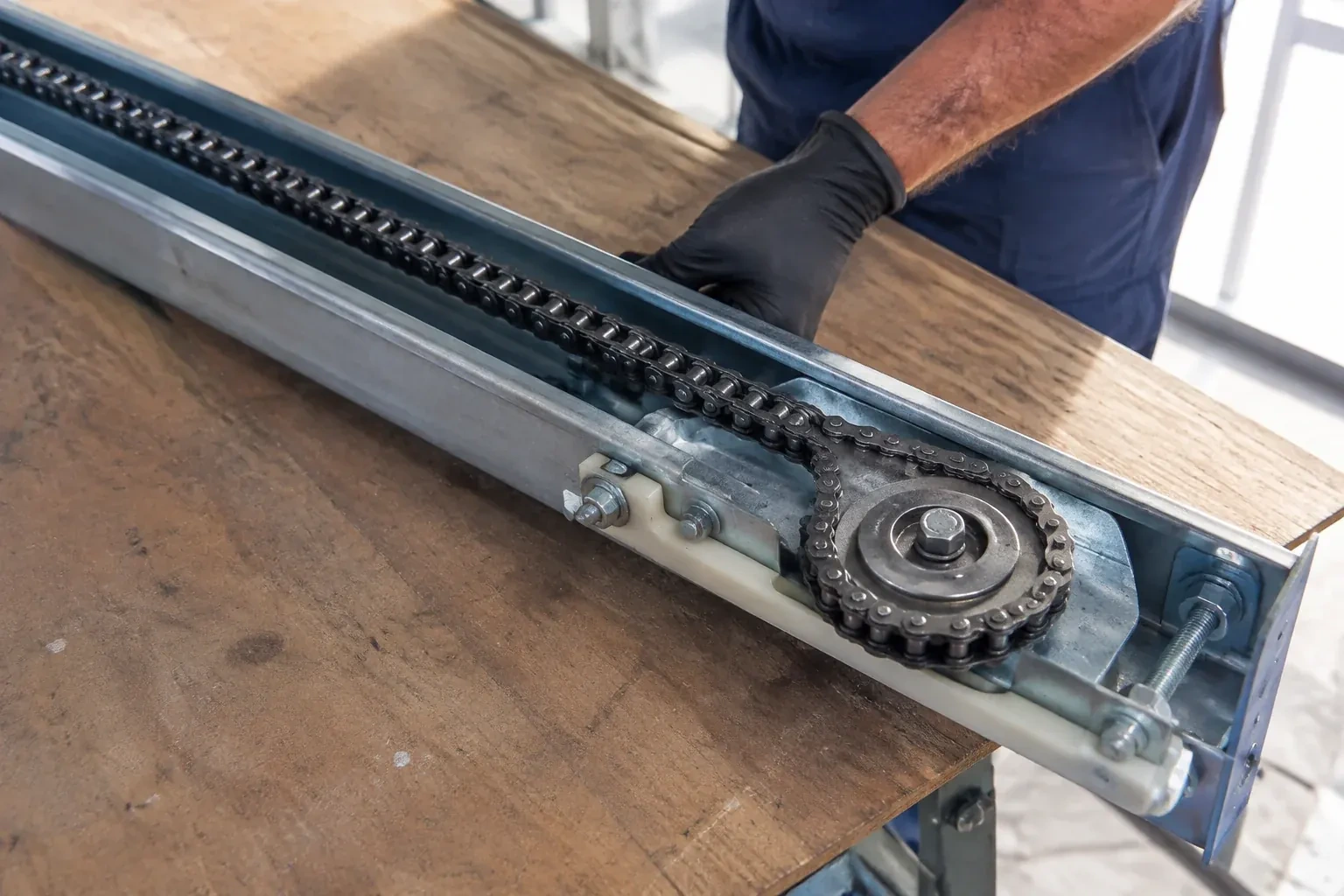
- Belt-Drive Opener RepairIt is minus twenty in the detached garage and the door climbs in jerks, the belt stiff as a board.
- Garage Door Opener ReplacementPress the button and the motor hums, but the door stays exactly where it is.
- Photo-Eye Sensor Alignment or ReplacementAfter a cold night the door stays open until the garage warms up.
Garage Door Opener Diagnosis and Repair near you
Everything we do for garage doors in Auburn Mills starts with a proper look at the whole door. From there the service might be a small adjustment, a set of new rollers, a spring replacement, an opener repair or a new door. The pages here explain each option so you can follow the reasoning.