Openers · Warsaw
Belt-Drive Opener Repair in Warsaw
It is minus twenty in the detached garage and the door climbs in jerks, the belt stiff as a board. By the afternoon, when the sun has been on the door, it runs almost normally again.
Belt-Drive Opener Repair
In plain words
Winter is a good season to have a belt drive looked at. Rubber stiffens in a cold detached garage, so a belt tensioned on a warm day can run tight and noisy in January, and a bottom seal frozen to the slab makes the operator reverse before the door has moved. Belt-drive opener repair in cold weather sets tension to the maker's specified measurement, frees a trolley release that has stiffened, frees a door frozen to the floor before the opener moves it, and puts a cold-rated lubricant on the door hardware. The belt stays dry; the hinges, rollers and springs get the care.
How the visit goesThere is a new squeal from the front of the rail, up near the header, on every cycle. The belt has started tracking to one side and its edge is fuzzy where it has been rubbing.
Warsaw
How the visit goes
How tight is tight enough
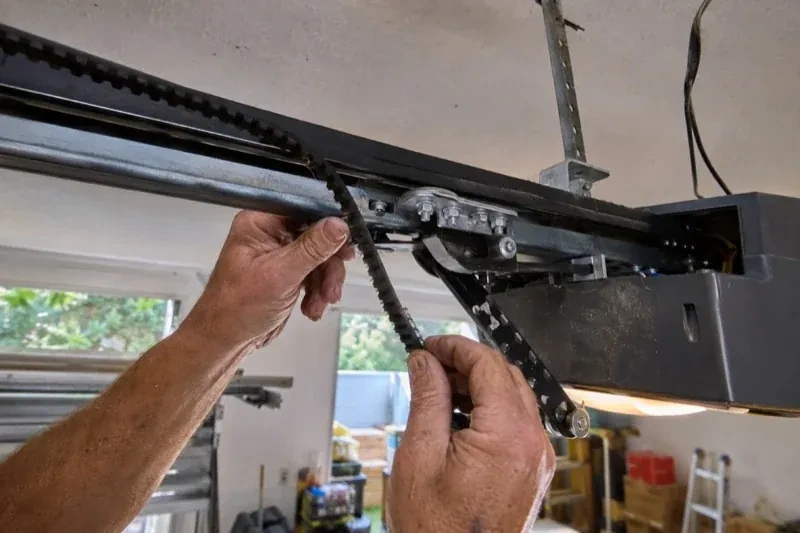
Belt tension is measured, not guessed. At the inner trolley a threaded shaft carries a coil spring and a square nut; turning the nut draws the belt tighter and compresses the spring, and the maker states the spring length that means the belt is right, roughly the width of a thumb. The technician checks that length, presses the belt at mid-span for a little give, and watches it run. A belt hanging below the rail is loose and will skip teeth. A belt pulled drum-tight makes sprocket noise, loads the motor bearings and wears the idler pulley. Both are corrected on the spot, and an adjuster wound to its end tells the technician the belt has stretched past saving.
Idler pulley and the front of the rail
A squeal or a belt tracking to one side leads to the idler pulley at the header end of the rail. With the belt slack, the pulley's axle bolt is removed, the worn pulley and its bearing come out of the rail end, and a new pulley goes in on a clean axle. The technician spins it by hand for smoothness, sights the rail to be sure the pulley sits square, and re-tensions the belt. Where the rail itself was bent or a hanger had let it sag, the rail is straightened or re-hung level before the belt is run. The belt edge that was fraying is inspected; if the cords are exposed, the belt is replaced too.
The red cord, and what to do after you pull it
You now know where the release handle hangs and what happens when you use it. A pull parts the trolley so the door can be lifted by hand through a power cut; running the motor, or a second pull, reconnects it. What matters after this repair is to pull it only with the door closed. Releasing a door that is open, or one whose springs are tired, can let it fall because the spring no longer carries its weight; the release itself disconnects the trolley from the belt, so the falling door lands on its tracks and hinges, not the belt the technician just corrected. Practise it once with the door down so the first real use is calm.
Belt-Drive Opener Repair
In the van
- Rail hanger straps and fasteners
- Reinforced drive belt with clip
- Garage-door lubricant for hinges and rollers
- Photo-eye sensor pair
- Rail joint brackets and stop bolts
What affects the quote
Same fees day, night or weekend
1Height of the ceiling
Where the operator hangs under a tall or vaulted ceiling, the sprocket and idler are reached from taller ladders and the work at the head takes longer.
2Door work found during the balance test
If the door is heavy in the hands when lifted with the operator released, the springs, cables or rollers behind that are priced as their own job, separate from the belt.
3Trolley condition
A trolley that releases and re-engages cleanly stays. One that is cracked, stuck or loose on the rail is replaced during the same visit and listed as its own part.
Belt-Drive Opener Repair: questions
Why does my belt drive clatter like a chain drive now?
Sprocket noise on a belt drive almost always means tension is wrong in one direction or the other. A slack belt skips teeth on the sprocket and slaps the rail; a belt pulled too tight grinds on the sprocket and strains the motor bearings. Both sound harsh. Setting the tension spring to its proper length, and checking that the sprocket and idler pulley are not worn, brings the quiet back.
How long should a belt last once repaired?
A belt's life is counted in cycles and years, and on a balanced door with the rail straight and the tension right it runs for many years. What shortens it is a heavy door, an over-tight adjustment, a bent rail rubbing one edge, or grease on the rubber. Keep the door balanced and lubricated, the belt dry, and glance along the rail a few times a year.
Can I adjust the belt tension myself?
The adjustment nut is reachable and some owners do, but there are two things to get right. The operator must be unplugged and the door released first, and the spring must be set to the maker's length rather than tightened until the sag disappears, since an over-tight belt is noisy and hard on the motor. After any change, the reversal tests should be repeated. Many people prefer to have it done during a service.
Openers & Access
Belt-Drive Opener Repair near you
We think of garage door work in Warsaw as keeping a heavy moving object safe and smooth. That covers spring and cable work, tracks and rollers, opener force and sensor settings, seals against the weather, and complete door replacement when a repair no longer makes sense.